Wednesday, 7 March 2018

Soundscape - Complete


Organic, flexible, bendy, stretchy, gritty, slow, growing, rigid.
This image is happening in a space which is underwater, as the structure is large and needs that environment to support its weight. Much like coral it moves to lessen structural resistance and grow.


Organic, Slippy, smooth, compacted, dry, swollen, bubbly, rubbery, slick, undulating. This image is telling me it belongs in a forgotten place, possibly a growth in a sewer, or a moist cavern somewhere biologically it can thrive.


This image is loud, fizzing, gleaming and werring. It rumbles and explodes. It vibrates in a space which is endless.   

Below is a list of noises which helped me create sound for these three images. 


Thursday, 1 March 2018

Film Review - Close encounters of the Third Kind (1977)

 Figure 1

Close Encounters is at first what appears to be about aliens and life outside of our solar system. It appears to be an epic of discovery and gaining knowledge which is currently light-years ahead of us. Once the surface is scratch, the majority of "The film is more of a drama with conspiracy thriller overtones." (Sobczynski, 2017) suggests, which is arguably what the majority of the film is concerning, the plot to evacuate the area of Wyoming due to 'nerve gas', along with keeping the public in the dark about certain things, interrogation and deportation are possibly factors in the conspiracy which can be likened to many events concerning government in real life. This makes the film arguably very relatable to the audience, and lends weight to the narrative because there is a connection resonating with our own curiosity and primal urges from sentience which drives us to constantly learn, question why and ask ourselves what our place in the universe means. 

Figure 2

The sound score in Close Encounters is remarkable and serves to enhance the experience, "It’s the perfect accompaniment to Spielberg’s wondrous, awe-inspiring movie." (guzman, 2017), convincingly so as mood and pace would struggle to be set as is intended without the use of the sound. There is something which fills the audience with joy and listening to the music cunningly created from the aliens spacecrafts diegetic sound. Imagining a space faring species which communicates through the use of music is totally whimsical and joyful. 

Figure 3

It's arguable that the reason we enjoy this film so much is the ability we possess to in some way relate to the protagonist, "It turns you, the viewer, alongside Roy, into a preoccupied, vision-driven auteur, and you can forget about that noisy, mundane domestic life in Muncie." (Phillips, 2017) Phillips suggests, we do this because the addition of the frontal lobe in our brain (which sets us apart from animals and arguably the reason we have 'sentience') allows us to wonder and forward think a scenario. This drives our hunger for knowledge and greases the wheels of evolution. We long to be fascinated and inspired. This is exactly what Spielberg hands us on a plate.  


Bibliography:


Phillips, M. (2017). ‘Close Encounters’: Messy as it is, it means more to me than 'Star Wars' ever did. [online] chicagotribune.com. Available at: http://www.chicagotribune.com/entertainment/movies/sc-mov-close-encounters-40th-anniv-0831-2017-story.html [Accessed 1 Mar. 2018].


Guzman, R. (2017). ‘Close Encounters’ still soars 40 years later. [online] Newsday. Available at: https://www.newsday.com/entertainment/movies/close-encounters-of-the-third-kind-review-steven-spielberg-s-classic-still-mesmerises-1.14102669 [Accessed 1 Mar. 2018].


Sobczynski, P. (2017). Close Encounters of the Third Kind Movie Review (1980) | Roger Ebert. [online] Rogerebert.com. Available at: https://www.rogerebert.com/reviews/close-encounters-of-the-third-kind-2017 [Accessed 1 Mar. 2018].


Illustrations:


Figure 1 - Close Encounters of the Third Kind (1977) [Film] - Steven Speilberg: Columbia Pictures
  
Figure 2 - Close Encounters of the Third Kind (1977) [Film] - Steven Speilberg: Columbia Pictures

igure 3 - Close Encounters of the Third Kind (1977) [Film] - Steven Speilberg: Columbia Pictures

Film Review - Jaws (1975)

 Figure 1

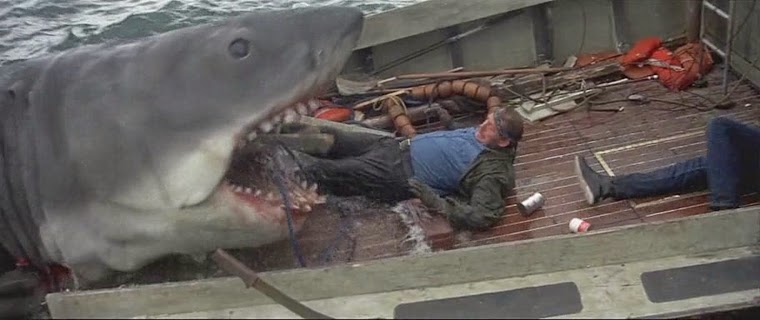
Like so many great features it is often that the premise is simple and small, but the scope is huge. This is a strange concept but it works because we can imagine more when we have a boundary, it is arguable that Jaws is this idea personified,  'shark lurks in tourist heavy beach location'. 
"What Spielberg and his team have done is to pare Peter Benchley’s pulp novel down to essentials and then to play it for all its bare bones are worth." (Malcolm, 2016), this suggests that from its more indepth novel Spielberg has seen the scope of what it really is and adapted it visually in a way which strips it down to the most immersive and enthralling way possible.  

Figure 2

One of the techniques often used, since Alfred Hitchcock best described suspense was putting a bomb under the table and it not going off. Spielberg here keeps the monster hidden right up until the end, where even then
"We are often looking at kegs and not at a shark, but the premise is so well established that the shark is there." (Ebert, 2000) supposing that the imagination has built up a monster so much that subtlies employed like this dramatise them in a way we are conditioned to interpret them. 

Figure 3

Spielberg has used simple details paced well in order to build suspense and give Jaws the horrific persona which it deserves, Rothman suggests that "The movie is very like its subject. If the great white shark that terrorizes the beaches of an island summer colony is one of nature’s most efficient killing machines, Jaws is an efficient entertainment machine." (Rothman, 2015) an audience can there for be compared to the tourists and the characters which are terrorised by the shark. 


Bibliography:


Ebert, R. (2000). Jaws Movie Review & Film Summary (1975) | Roger Ebert. [online] Rogerebert.com. Available at: https://www.rogerebert.com/reviews/great-movie-jaws-1975 [Accessed 1 Mar. 2018].


Malcolm, D. (2016). Jaws - the original Guardian review: archive, 22 Dec 1975. [online] the Guardian. Available at: https://www.theguardian.com/film/2016/dec/22/jaws-steven-spielberg-1975-review-derek-malcolm [Accessed 28 Feb. 2018].


Rothman, L. (2015). Read TIME's Original Review of 'Jaws'. [online] Time. Available at: http://time.com/3894762/jaws-1975-review/ [Accessed 1 Mar. 2018].


Illustrations:


Figure 1 - Jaws (1975) [Film] - Steven Spielberg: Universal Pictures 


Figure 2 - Jaws (1975) [Film] - Steven Spielberg: Universal Pictures 


Figure 3 - Jaws (1975) [Film] - Steven Spielberg: Universal Pictures 

Film Review - Duel (1971)

Figure 1

Duel as a film is incredibly simplistic, its premise is tiny but its scope is massive. It can be shortened down simply to Car Chase, a possible forerunner to films such as the recent Mad Max Fury Road. Visually there is nothing special going on during the film, but when the consideration of the camera enters the mix our perception of events is changed, Janet Maslin remarks that ''Duel'' might almost have been a silent film, because it expresses so much through action and so little through the words that are here." (Maslin, 1983). This is arguably true because even though through music and sound effects you can create emotion and tone the impressive thing which absorbs us here is the death defying chase along narrow cliff edges ravines. It creates a totally immersive experience for the viewer, and this is why it is fundamentally a much talked about film.  


Figure 2

The Antagonist of this feature is the Truck. Its a monstrous and grotesque machine which applies pressure throughout gradually creating deep seated panic in everyone concerned including the audience. It is arguable that the reason we are so able to associate the truck with this is summed up by Greg Moss in his feature review of Duel "The concealment of the truck driver’s identity allows the truck itself to take on its own persona." (Moss, 2014) meaning instead of simply having a machine which runs on fuel and is completely lifeless, as it has no one to control it is seems animalistic and uncontrollable. There is no ability to understand or communicate with it, its appearance of the battered, rusted and 'flammable' entitled body work gives us a sense which furthers this about its persona.

Its appearance also lends weight to believing it has complete and utter placement in its environment and belongs there. It is readily apparent that once Mann has left the city, he is in the trucks territory. 


Figure 3

There is an underlying theme of Masculinity during the feature also. Howard points out that "The brief conversation colors the entire film, as does the radio program that Mann listens to during the introductory scenes." (Howard, 2011), regarding this, we begin to make constant assumptions about the environment, and characters involved. The Comparison between the Hulking rusty Peterbilt 281 truck and the little red Plymouth Valiant demonstrates a contrast between how demasculated Mann is presented, and his constant struggle to gain control over a situation he would never be able to have thew upper hand in. It is possible to contrast the environment to the struggle of Mann dealing with the confrontation of his boss hitting on his wife, the hostility of the environment and the leap to assertion is arid and harsh, it could been seen that its an obstacle he must conquer in order to come out the other side with renewed masculinity. Unfortunately it would seem that even after the constant stomach churning car chase, the only way Mann is able to gain anything back is to suicide his own vehicle in an effort to stop the truck from more onslaught. The fact if this act meant he would never finish is mission to confront his boss and he has sacrificed his only form of power in this situation.      

Bibliography:


Howard, E. (2011). Duel. [online] Seul-le-cinema.blogspot.co.uk. Available at: http://seul-le-cinema.blogspot.co.uk/2011/02/duel.html [Accessed 28 Feb. 2018].

Maslin, J. (1983). Movie Review - - 'SPIELBERG'S 'DUEL,' FOUR-WHEEL COMBAT - NYTimes.com. [online] Nytimes.com. Available at: http://www.nytimes.com/movie/review?res=9804EFD81138F936A25757C0A965948260 [Accessed 28 Feb. 2018].


Moss, G. (2014). Steven Spielberg’s Duel – feature review. [online] mossfilm. Available at: https://mossfilm.wordpress.com/2014/12/18/steven-spielbergs-duel-feature-review/ [Accessed 28 Feb. 2018].

Illustrations:

Figure 1 - Duel (1971) [Film] - Steven Spielberg: George Eckstein: Universal Pictures

Figure 2 - Duel (1971) [Film] - Steven Spielberg: George Eckstein: Universal Pictures

Figure 3 - Duel (1971) [Film] - Steven Spielberg: George Eckstein: Universal Pictures


Year 3 - Major Submission - Reflective statement

This is a reflective statement for my 3rd year of 3D computer Animation Arts.  I shall outline what it was that I achieved this year, I...